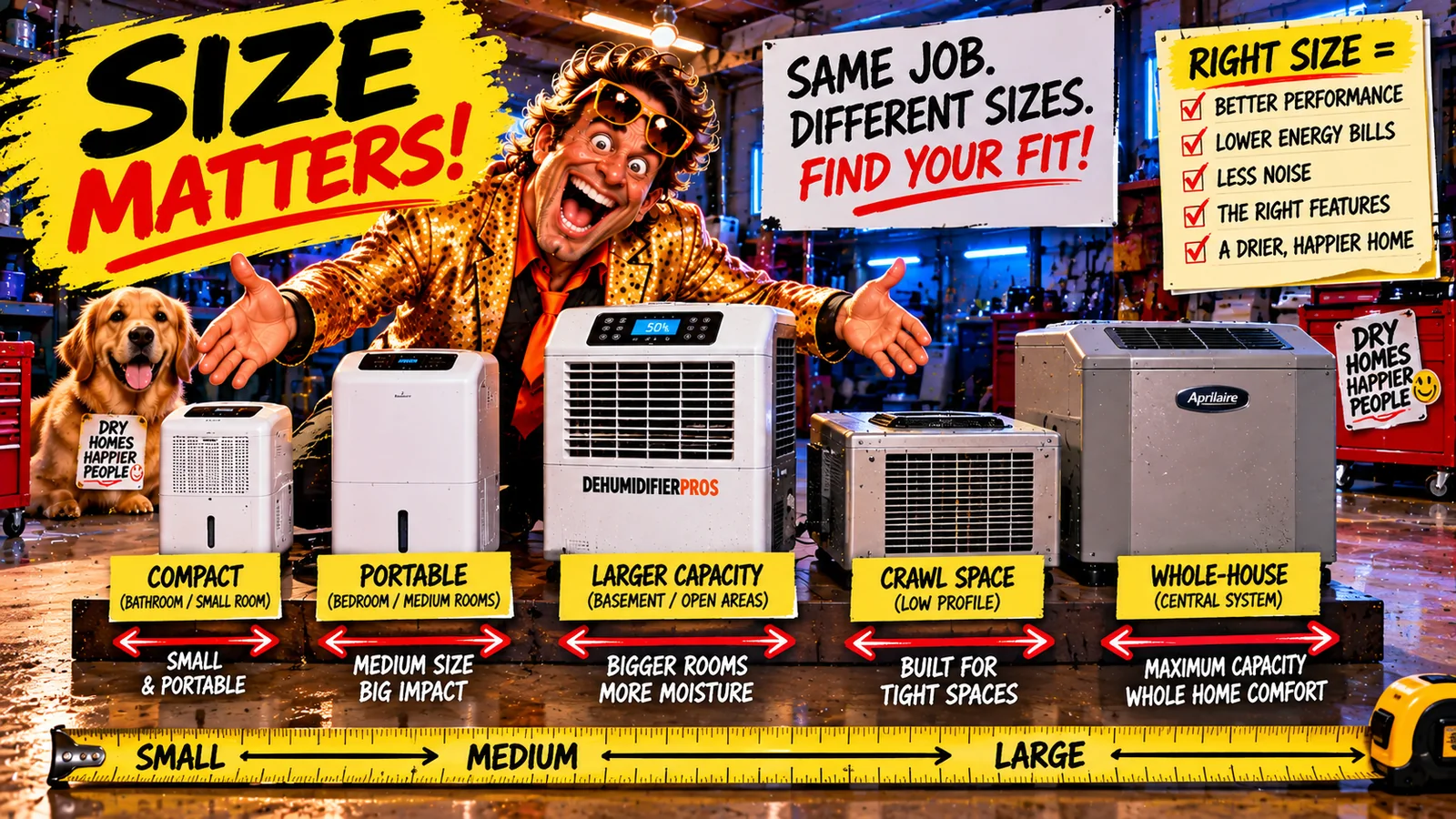
THE VERDICT: Buy enough water-removal capacity for your actual dampness problem, not the largest square-footage number printed on a shiny cardboard box. A slightly larger room that’s only mildly damp may be easier to control than a small basement getting hammered by moisture every day. Size matters. Moisture load matters more. And a disconnected, cold, leaking basement gets to rewrite the entire damn rulebook.
Start with the equipment class, not a magic number
For an ordinary connected residential room with a persistent but manageable moisture load, a conventional portable compressor dehumidifier is generally the starting class. Where moisture is heavy but still within practical portable duty, consider a suitable higher-removal portable. Where the site is a persistent basement or crawl-space installation with demanding temperature, accessibility, drainage, or service requirements, evaluate dedicated residential equipment instead.
A tiny thermoelectric unit may have a legitimate job in a very small, light-moisture setting. It is not a substitute for a room-scale compressor machine just because the listing promises to cover a heroic number of square feet.
Stop right here for active water entry. Leaking pipes, standing water, groundwater intrusion, and soaked materials require source correction before equipment shopping.
What the pint rating really tells you
Dehumidifier capacity is commonly described in pints of water removed per day under defined test conditions. That’s a moisture-removal rate, not the size of its collection bucket. Tank volume tells you how much water the machine can hold before it needs emptying; it does not tell you how much it can remove in 24 hours.
Test conditions matter. Room temperature and humidity affect real-world moisture removal, and advertised figures from different technologies are not automatically apples-to-apples. A pint is a volume unit, but a larger advertised daily figure alone does not tell you how the machine will perform in your colder basement or quiet bedroom.
Manufacturer coverage-area claims are marketing starting points, not promises that the appliance will control every separated room in a stated area.
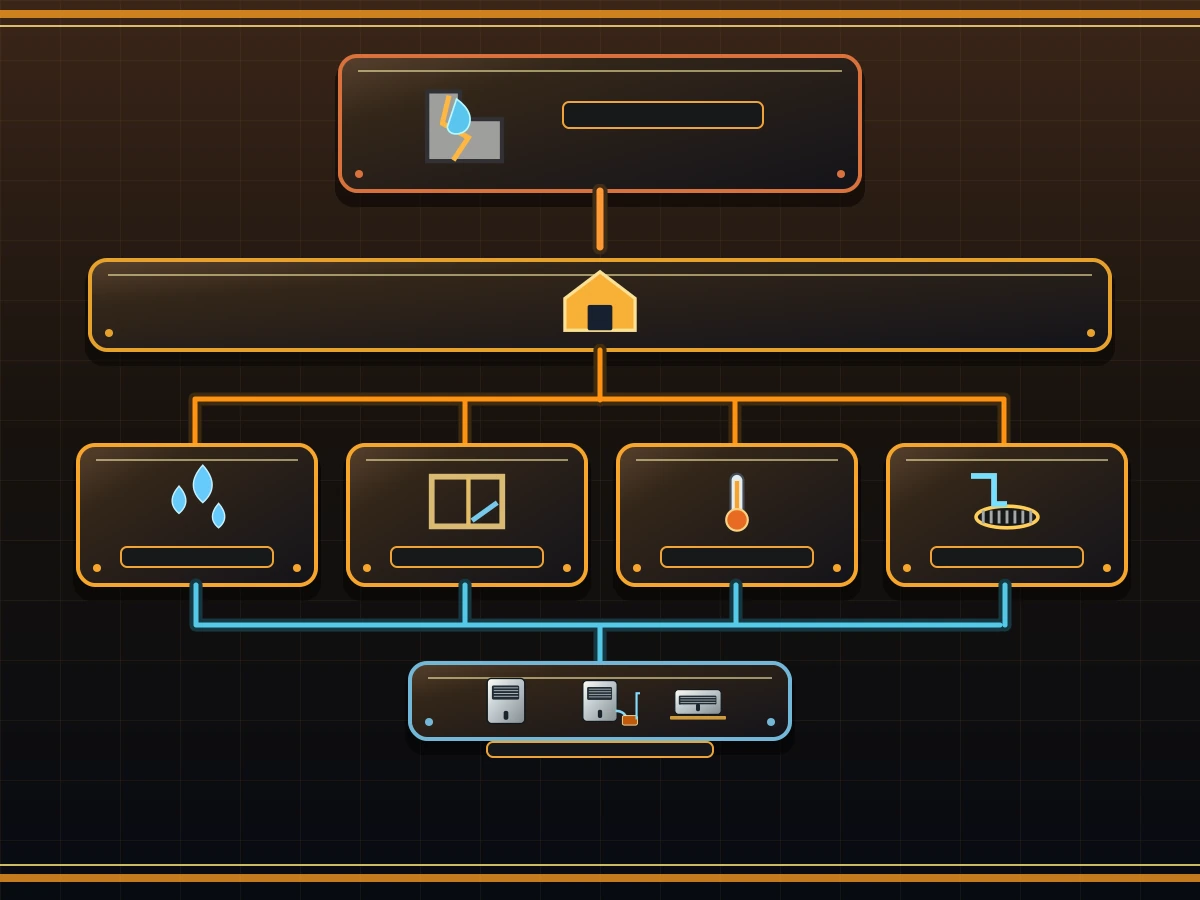
Five things that actually decide the size
- How much moisture is present? Measure indoor humidity with a hygrometer and examine recurring condensation or mustiness. Mild seasonal stickiness is a different workload from moisture that returns immediately after drying.
- Is new water constantly entering? A leak or wet foundation can overwhelm a suitable machine. Solve the entry issue before escalating capacity.
- How is the air connected? Open areas allow more air exchange. Closed doors, interior walls, levels, and long hallways can leave one machine serving one zone while another remains damp.
- What temperature will it operate in? A cooler basement or crawl space can change appliance suitability. Confirm the selected model’s published operating range and defrost behavior; don’t assume every portable belongs in every low-temperature environment.
- How will you remove the water? A full bucket interrupts unattended operation. Continuous gravity drainage needs a continuously downhill path; a raised discharge may need a suitable pump. This is a drainage decision, not an automatic reason to buy a higher-capacity machine.
Which class should you buy?
| Homeowner condition | Initial equipment decision | What not to waste money on |
|---|---|---|
| Small, genuinely light and localized moisture load | Consider passive moisture control before buying a powered machine. | An oversized compressor machine for a tiny enclosed space. |
| Ordinary, manageable residential dampness in a connected zone | Begin with the standard portable class. | Choosing purely by claimed square footage. |
| Persistent heavier load, still suitable for portable equipment | Assess the higher-moisture portable class. | A mini unit struggling continuously at an impossible task. |
| Portable fits but condensate must rise to a drain | Choose the right pump-assisted configuration. | Paying for extraction capacity when the real problem is drainage. |
| Persistent basement/crawl-space duty, demanding conditions or access | Evaluate dedicated residential equipment. | Assuming an ordinary upright portable belongs in every crawl space. |
These are application states, not hard square-foot thresholds. Some conditions overlap. Use the recommendation page corresponding to the actual job; it owns the researched product choices and their qualified merchant exits, with exact-model and purchase caveats.
When one machine is the wrong number
One portable dehumidifier cannot be assumed to dry disconnected rooms through closed doors. A unit in an open living area may serve its connected zone while a closed bedroom remains humid. Before buying a second machine, check whether the moisture is really persistent in both zones and whether an airflow or source problem is the true culprit.
Don’t forget the water has to go somewhere
Don’t take home a dehumidifier with a great rated capacity and a miserable emptying routine. Decide between bucket, gravity hose, and pump using our drainage guide before you compare features. Continuous operation depends on the machine, the drain arrangement, and site conditions, not just the model’s advertised pint figure.
Bruce’s final sizing rule
Fix water entry first. Pick the right equipment class for the measured moisture job. Verify temperature, airflow, and drainage. Then choose a current product that actually fits. If a cheap competent portable does it, buy that one. If a dedicated machine is justified, buy that instead. But don’t let a giant square-foot number make the buying decision for you.