THE VERDICT: Choose the water exit before you buy the machine. If you can empty a bucket reliably, a bucket may be enough. If there’s a safe, suitable drain lower than the unit, gravity drainage is the cheap hero. If the water must climb uphill, you need a properly specified pump, not a pep talk from Bruce and certainly not a bigger dehumidifier.

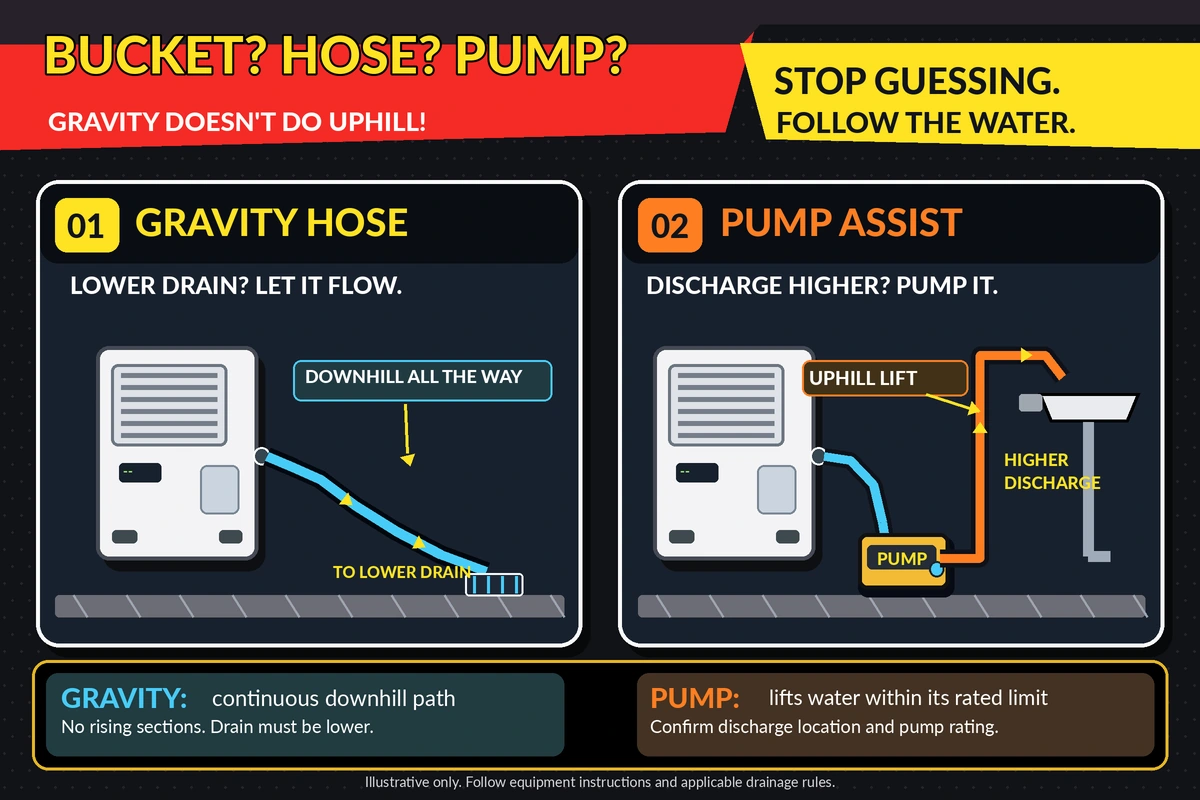
Three practical choices, one job
| Setup | Right for | Main drawback |
|---|---|---|
| Collection bucket | Occasional use, accessible rooms, or places without an approved continuous drain. | You’ll empty it. A full-bucket switch commonly interrupts collection until the bucket is serviced. |
| Gravity-drain hose | A compatible model with a continuously downhill hose route to a suitable lower receiving drain. | No uphill travel. Sags, kinks, clogged hose ends, or a bad drain destination can stop reliable discharge. |
| Condensate pump | A compatible setup where condensate must be lifted to a higher or more distant approved receiver. | Added cost, noise, power, maintenance, and another failure point. Pump lift, tubing, overflow handling, and receiving connection must be verified. |
Decision one: can gravity do the job?
Inspect the entire route from the dehumidifier’s drain outlet to its final discharge point. A gravity hose only works when the outlet and receiving geometry allow condensate to flow continuously downhill. A hose that rises to a utility sink has not magically become a pump because the seller called it a “continuous-drain option.”
Check that the chosen dehumidifier actually supports the hose connection; some systems use specific fittings, adapters, or operating modes. Route the hose so it won’t be stepped on, crushed by a door, or left with water-trapping loops. Verify the drain is approved and can receive the water without backing up.
Buy nothing extra when the included, compatible gravity connection and a lower drain already solve the problem. That’s money you can spend on literally anything better than an unnecessary pump.
Decision two: is the water going uphill?
Then gravity is officially off the payroll. You need an internal pump model designed for that job or a compatible external condensate pump. Neither choice inherently increases how many pints the dehumidifier removes from the air.
Check the actual discharge height and route length against the pump’s manufacturer documentation. Verify acceptable tubing, appropriate receiving point, access for cleaning, and how overflow or pump failure is handled. Don’t improvise electrical wiring or assume a generic accessory is universally compatible.
For a portable with a properly justified pump requirement, continue to the pump-equipped portable recommendation. For the fundamental equipment comparison, use Find Your Machine.
Decision three: is the bucket actually a problem?
In a lightly damp, regularly occupied room, a bucket may be the sensible, cheap arrangement. The collection tank does not need to be large to achieve a rated daily moisture-removal figure, but a small tank can mean frequent trips to empty it under wet conditions. If you routinely forget the tank or need unattended operation, continuous drainage becomes more important than another flashy control-panel feature.
Do not route discharge into a place that will wet building materials, flood a floor, or introduce a new moisture problem. The point of drainage is to remove the collected water from the problem space, not give it a scenic tour of the basement.
When buying a new dehumidifier is a waste
Already own a suitably sized, working machine with compatible drainage? You may need only the correct hose arrangement or a verified external pump, not an entirely new appliance. Conversely, don’t buy a pump to rescue an undersized machine that cannot manage the room’s actual moisture load.
If the underlying issue is a leaking pipe, active seepage, or standing water, read What a Dehumidifier Won’t Fix before buying accessories. A pump attached to a dehumidifier is not a substitute for correcting the water source.
Bruce’s drainage rule
Bucket if you can manage it. Gravity hose if the full route is downhill. Pump if the water must rise and the equipment supports it. Then choose the dehumidifier class for the actual room conditions, not the other way around.
That is the entire magic trick. No ladder, no overflowing slosh bucket, no heroic garden hose pointing at a higher sink.