THE SMALL-SPACE VERDICT: Use a light-duty electric dehumidifier only for a small, genuinely low-load area when its documented collection rate fits the job and a passive absorber isn’t the better bargain. For actual room humidity, step into the compressor class.
Bruce has a pocket-size moisture fighter on a rotating showroom pedestal. It has a very small job. Don’t let the rotating pedestal make the job bigger.
The equipment class in plain English
Small electric collectors, often thermoelectric, can remove some moisture from a limited enclosed space. They tend to advertise lower collection rates than room-capacity compressor units, sometimes measured under especially warm, humid conditions. Be careful: a large tank does not mean fast extraction. Confirm the manufacturer’s per-day removal claim, the test conditions and actual electrical placement requirements.
| Use case | Our decision |
|---|---|
| Closet or small storage cubby; no plug wanted | Prefer passive control if practical. |
| Small enclosed utility niche with mild persistent moisture, usable outlet and easy tank access | Consider this light-duty powered class, with documented removal rate. |
| Bathroom after every shower, bedroom or humid basement | Usually the wrong class; choose room-scale equipment if source/ventilation corrections aren’t enough. |
| Active leak or soaked materials | Correct water source and damage; do not use a mini appliance as the main fix. |
Check these specifications rather than slogans
Read the actual moisture-removal rate, operating-temperature requirements, tank-full behavior, power needs and clearance limitations. Beware wording such as “covers up to X sq ft” without a meaningful extraction measure. A tiny unit running all day may be functioning exactly as designed while accomplishing very little on a room-scale problem.
The product trap
Our tightly limited pick: Eva-Dry EDV-1100 Electric Petite Dehumidifier. Buy it for a small, lightly damp enclosed location where you have a safe outlet, a place to position the device, and time to empty its tank. Do not buy it to dry an ordinary bedroom, a shower-soaked bathroom, or a basement.
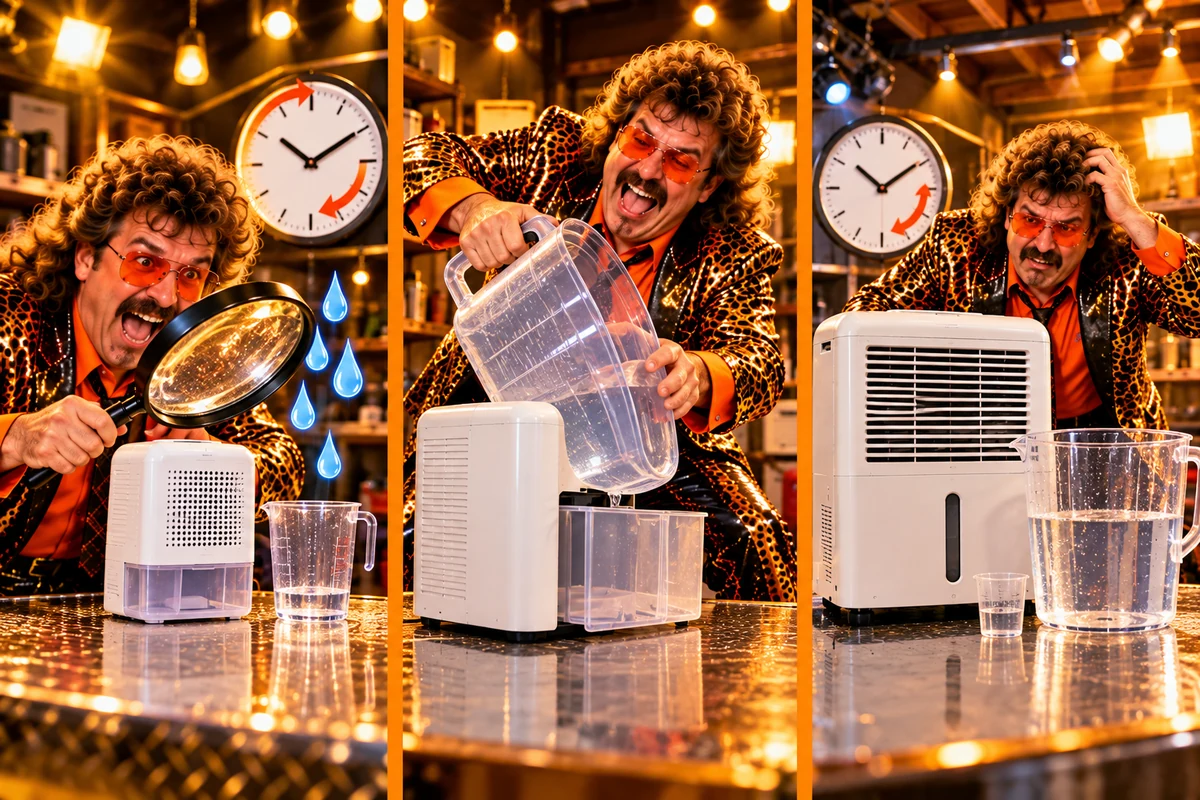
The manufacturer’s EDV-1100 manual specifies approximately 8 ounces per day at 86°F and 80% RH, with a 16-ounce holding tank. That is a useful reality check: a 16-ounce tank is not a 16-ounce-per-day extraction promise. Results at cooler or less-humid household conditions can be substantially smaller. At this scale, passive absorbers may still be the better no-outlet bargain.
Drawbacks: modest removal rate, electric placement requirements, periodic emptying, and little headroom when the actual moisture load rises. This is a niche product recommendation—not a compressor substitute.
Affiliate disclosure: As an Amazon Associate I earn from qualifying purchases. DehumidifierPros may receive a commission from qualifying purchases through links on this page, at no extra cost to you. These are researched recommendations, not claims of firsthand DHP testing.
Exact model: Eva-Dry EDV-1100. Check Eva-Dry EDV-1100 on Amazon.
Prices, availability, sellers and product variants can change. Confirm the exact model and included features before ordering.
Read the EDV-1100 manufacturer manual for capacity, electrical setup and use restrictions.
When to choose a compressor instead
Repeated condensation across a room, persistent high humidity in occupied space, or a collector that cannot meaningfully lower measured humidity calls for a different response. First examine the source; then compare standard portable dehumidifiers instead of trading one little novelty box for another.
Bruce’s miniature sales rule: Match the tiny appliance to a tiny job. A humid house doesn’t get a participation trophy.